

Why Your AMS Selection Is Taking Twice as Long as It Should
- 3 days ago
- 5 min read
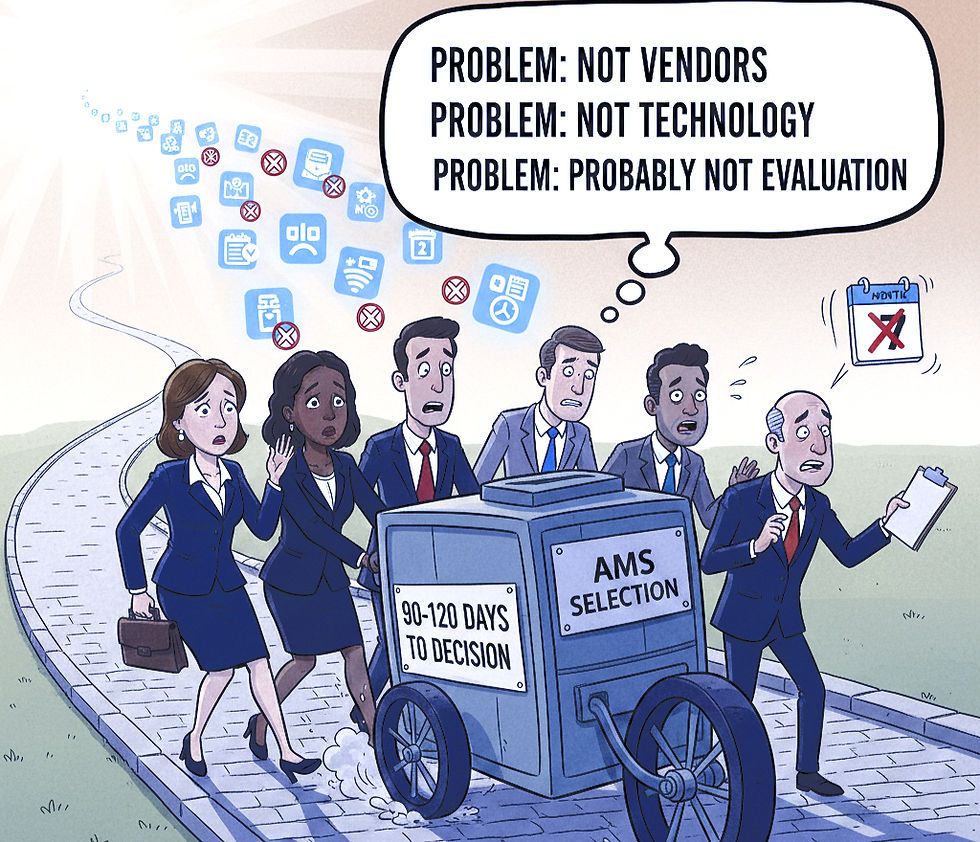
Your AMS selection should take 90-120 days. If you're past month six with no signed contract, the problem isn't the vendors. It's not the technology. And it's probably not your evaluation criteria.
It's the way the project is being managed—or not managed at all.
According to InformationWeek, 49% of enterprise software selection projects exceed six months. But here's what those statistics don't tell you: the evaluation work itself takes 90-120 days. The other six months? Internal delays, calendar conflicts, and the annual conference that keeps pushing your decision to "next quarter."
Every month of delay costs you. Contract extensions with your current vendor. Staff frustration is mounting. The member engagement problems you're trying to solve are getting worse. And somewhere in the back of your mind, that nagging question:
Are we ever actually going to finish this?
You are. But only if you understand what's really driving your timeline.

The Two Numbers That Explain Everything
90-120 days: How long does an AMS selection take for Tier II and Tier III associations when someone is driving accountability, maintaining momentum, and keeping the project on track?
9-18 months: How long does the same project take when it's managed "when we get to it," squeezed between competing priorities, with no one owning the deadline?
The work is identical. The difference is in structure. Before you blame the process, make sure you're solving the right problem. Sometimes the issue isn't your AMS—it's how you're using it.
If optimization could fix your pain points, you'll save a year of selection effort and tens of thousands in switching costs. Find out in 2 minutes: Is replacement actually necessary? →
Why Your Timeline Is Probably Wrong
Most associations underestimate selection time because they confuse two separate projects:
Selection = choosing your vendor (requirements through a signed contract)
Implementation = configuring, migrating, training, and going live
Vendors blur this line constantly. "You could be live in six months!" Sure—if you've already selected them. Selection adds another 3-4 months minimum.
The other variable nobody mentions? Your tier.
Implementation timelines by tier:
Tier IV (under $500K budget): 2-4 weeks
Tier III ($500K-$3M budget): 4-6 months
Tier II ($1.5M-$8M budget): 6-9 months
Tier I ($10M+ budget): 12-18 months
A Tier III association planning for a "quick" 3-month implementation is setting itself up for failure. A Tier I enterprise expecting 6 months is delusional.
Your tier determines everything—your vendor shortlist, your realistic timeline, and your implementation complexity. Most associations guess wrong. Find your actual tier in under 3 minutes →
The Four Factors You Actually Control
1. Decision-Making Structure
How many people need to approve the final choice? Info-Tech Research Group found that selection satisfaction peaks with teams of three to five people. Larger committees don't produce better decisions—they produce slower ones.
If your selection requires board approval, multiple committee sign-offs, and consensus among six department heads, add 60+ days to any timeline estimate. Not because the evaluation needs it, but because calendars don't align.
2. Leadership Commitment
"We'll work on this when things slow down" is a death sentence for selection projects. Things never slow down. The associations that finish in 90 days protect time for the project. The ones that take 18 months treat it as side-of-desk work.
3. Data Readiness
Clean data migrates quickly. If your current system contains duplicate records, inconsistent formatting, and five years of "we'll fix that later" decisions, add weeks or months to implementation. Start cleanup now—don't wait until you've signed the contract.
4. Customization Appetite
Configuration uses existing platform capabilities. Customization builds new functionality. Every custom workflow extends your Tier I timeline by weeks or months. Most Tier II and III associations can accomplish their goals through configuration alone—if they choose a platform that actually fits.
The Hidden Killer: What's Really Causing Your Delays
It's not technical complexity. It's not vendor responsiveness. It's internal politics.
The most common timeline killers:
Board members requesting "one more demo" with a vendor their golf buddy recommended
Key stakeholders are unavailable for six weeks during conference season
Fear of making the wrong choice, leading to analysis paralysis
No single personis empowered to say "we're deciding by this date."
A 4,000-member professional society started its search in February. By the following April—fourteen months later—they still hadn't signed a contract. The evaluation work would have taken twelve weeks. Committee scheduling conflicts, board second-guessing, and competing priorities added twelve months.
The cost? Fourteen months of dues paid to a vendor they were trying to leave. Staff turnover due to frustration. And a membership team is still fighting the same data problems they'd hoped to solve a year earlier.
Just got handed an AMS project with unclear authority and competing priorities? The first 48 hours determine whether you finish in 90 days or 18 months. Get the framework that prevents drift →
What to Tell Your Board About AMS Selection
When leadership asks, "How long will this take?" don't guess. Give them the real numbers:
Selection: 90-120 days with focused effort, clear decision-making authority, and someone driving accountability. If decisions require multiple approval layers and the committee can only meet monthly, double it.
Implementation: Depends on tier. Tier III associations need 4-6 months post-contract. Tier II needs 6-9 months. Anyone promising faster is either cutting corners on training or hasn't seen your data.
Total project: For most mid-size associations, 9-15 months from kickoff to go-live. That's not slow—that's thorough.
The question isn't whether you can go faster. It's whether you can afford to go slower. Every month of delay is another month paying for a system that isn't working, another month of staff workarounds, another month of member experience problems you could have solved.

When DIY Becomes Expensive
Associations attempt DIY selection to save money. But when internal priorities keep resetting the clock, the "savings" evaporate.
Consider the math: If your selection drags from 4 months to 14 months, you've paid 10 extra months to your current vendor. At $3,000-$10,000/month for a mid-size AMS contract, that's $30,000-$100,000 in delay costs—before counting staff time, frustration, and opportunity cost.
An experienced guide doesn't make the work easier. They make it happen. They maintain momentum when your team gets pulled into conference prep. They prevent scope creep when board members want to re-evaluate requirements. They hold the timeline when no one else will.
The difference between 90 days and 18 months isn't expertise. It's accountability.
Not sure where to start? The AMS Selection Toolkit gives you free frameworks, scorecards, and assessments used by hundreds of associations—no sales pitch, no registration wall. Get the free toolkit →
Want a realistic timeline scoped for your specific situation? SmartThoughts offers complimentary 20-minute consultations. No obligation, no pressure—just clarity on what your project actually requires. Schedule a conversation →


Comments